submitted by /u/nibblesec [link] [comments]
Vonn ‘confident’ she can race at Olympics with ruptured ACL in left knee
Lindsey Vonn is “confident” she can compete at the Milan Cortina Winter Olympics beginning this week despite the left knee injury she sustained in a crash four days ago.
Europe Eyes Its Own Nuclear Shield as Trust in US Security Wanes
submitted by /u/UNITED24Media [link] [comments]
You can stream 10 free movies a month with this hidden service – boasting 30,000 titles
All you need to start streaming is your library card.
The D Brief: Munitions makers, investing; DOD’s new science board; Troops won’t go to MN; Venezuela plan reflects Iraq lessons; And a bit more.
American munitions makers are working to increase production capacity. Although Congress didn’t much bend to the White House’s last-minute request for a munitions-funding boost, defense executives say it’s enough to persuade them to pour more of their own funds into boosting production, Defense One’s Lauren C. Williams and Thomas Novelly reported Monday.
“We’ve been getting the demand signals from the customer set long before now, whether that’s the amount of munitions that have been expended around the world, or just the stock of ammunition,” said Rylan Harris, who leads business development for Northrop Grumman’s armament systems business unit. “We’ve been seeing those demand signals already, which has helped us focus a lot of our investments in increasing capacity.” Read on, here.
Related: South Korea’s Hanwha Defense USA announced last week that it will spend $1.3 billion to build a factory at the Pine Bluff Arsenal in Arkansas to make ingredients for explosives, propellants, and munitions.
Mississippi Sen. Roger Wicker, chair of the Armed Services Committee, praised the development. “We need to bring new entrants into the American defense industrial base to increase competition and guard against single sources of supply, particularly on key programs like energetics and munitions. This agreement demonstrates how smart partnerships with allies can expand production against our mutual adversaries while reinforcing our domestic industrial base,” Wicker said in a statement Monday.
DOD launches science-and-innovation board as the U.S. cuts research. The new Science, Technology, and Innovation Board, which is a merger of the decade-old Defense Innovation Board and the 70-year-old Defense Science Board, is meant to “streamline” the department’s approach to the hardest technological and scientific national-security challenges. But it comes on the heels of Trump-administration cuts that could hinder those efforts. Defense One’s Patrick Tucker reports. Story, here.
Additional industry reading:
- “SpaceX acquires xAI, plans to launch a massive satellite constellation to power it,” Ars Technica reported Monday;
- The New York Times unpacked “The Numbers, and Questions, Behind Musk’s Mega-Merger,” reporting Tuesday;
- And “Palantir CEO defends surveillance tech as US government contracts boost sales,” Reuters reported Monday.
Welcome to this Tuesday edition of The D Brief, a newsletter focused on developments affecting the future of U.S. national security, brought to you by Ben Watson with Bradley Peniston. It’s more important than ever to stay informed, so we’d like to take a moment to thank you for reading. Share your tips and feedback here. And if you’re not already subscribed, you can do that here. On this day in 1917, the U.S. broke off diplomatic relations with Germany, which had announced a turn to unrestricted submarine warfare around the British Isles.
Deportation nation
New: Despite months of pleading by far-right influencers and Fox pundits, the U.S. military won’t send active-duty troops to Minnesota after all, the New York Times reported Monday. Airborne soldiers in Alaska and military police in North Carolina had been put on standby to deploy during aggressive ICE raids throughout Minneapolis last month, which triggered weeks of voluminous demonstrations from locals.
Trump threatened to invoke the Insurrection Act amid the unrest. But after the deaths of two American citizens at the hands of immigration agents on Jan. 7 and 24, the U.S. military’s Northern Command “quietly ordered the active-duty troops on standby to stand down,” a U.S. official told the Times.
In Oregon, a 53-year-old man was arrested after asking people at gunpoint if they’re a U.S. citizen. Among other actions along Interstate 5, he reportedly triggered a series of accidents before he was taken into custody by police on Thursday.
He shot at one victim. “That first shooting reportedly set off a series of crimes in which [the assailant] asked about another victim’s national loyalties, switched lanes and directions on the freeway, crashed into at least one victim’s vehicle and tried to steal a series of vehicles—including an ambulance that was responding to the scene,” the Roseburg, Oregon, News Review reported Monday. “No one was injured by the shooting, although at least one alleged victim was treated” at a local hospital for injuries from the collision.
Related reading:
- Homeland Security Secretary Kristi “Noem says body cameras are going to all DHS field officers in Minneapolis,” NBC News reported as talks over DHS funding continue in congress this week;
- Adam Serwer explains “The Real Reason ICE Agents Wear Masks,” writing Monday in The Atlantic;
- And “Federal Judge Temporarily Blocks End of Protection for Haitians in U.S.,” the New York Times reported Monday in a temporary legal setback for the White House; a DHS spokesman responded, “The final word [on this matter] will not be from an activist judge legislating from the bench.”
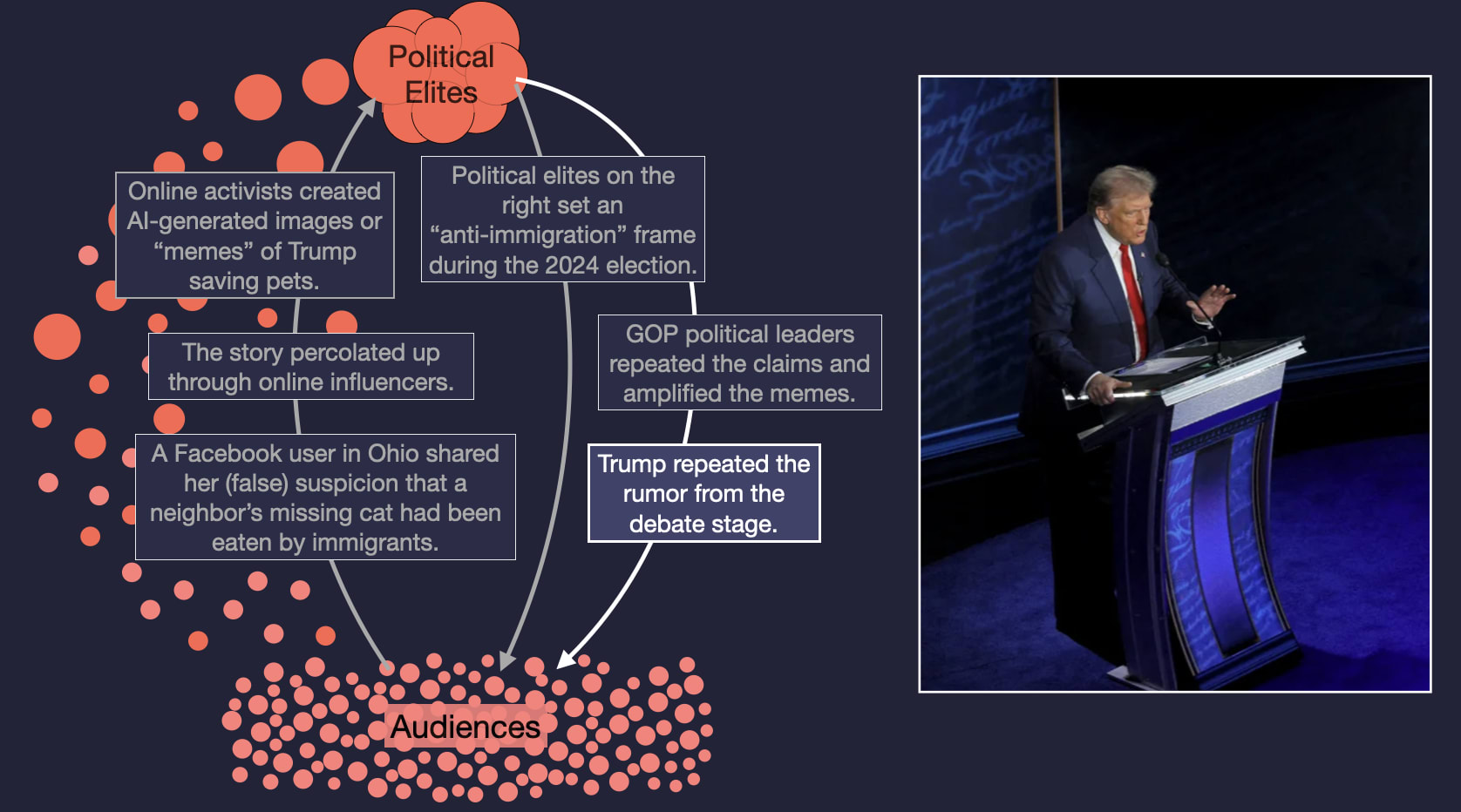
- Read more: Historian Tim Snyder explores the underlying dynamics, which began with unfounded rumors spread during the 2024 election campaign—recall Trump’s false claim “They’re eating the pets!” as University of Washington researcher Kate Starbird explained and documented in chart form over the weekend—in greater detail on Substack, here.
Trump 2.0
A whistleblower complaint alleging wrongdoing by Trump’s intelligence chief has been “stalled” for months, the Wall Street Journal reported Monday. It’s reportedly “locked in a safe” somewhere because it concerns Director of National Intelligence Tulsi Gabbard, and its disclosure could cause “grave damage to national security,” according to an official.
“The complaint was filed last May with the intelligence community’s inspector general, according to a November letter that the whistleblower’s lawyer addressed to Gabbard,” the Journal reports, two months after lawmakers were told about the broad contours of the case. That November letter “accused Gabbard’s office of hindering the dissemination of the complaint to lawmakers by failing to provide necessary security guidance on how to do so.”
The complaint itself is reportedly “so highly classified that [the whistleblower’s attorney] said he hasn’t been able to view it himself.” A spokesman for Gabbard called the complaint “baseless and politically motivated.” As for the delay, the Journal reports “A representative for the inspector general said the office had determined specific allegations against Gabbard weren’t credible, while it couldn’t reach a determination on others.”
It’s unclear exactly why the process has stalled for nine months, especially since sensitive facilities for sharing classified intelligence—SCIFs—have been available in Washington for decades. Experts called the delay unprecedented and noted the intelligence community’s “inspector general is generally required to assess whether the complaint is credible within two weeks of receiving it, and share it with lawmakers within another week if it determines it is credible.” That would have been nearly eight months ago.
But Gabbard had time to visit Atlanta after an FBI raid on an election center last week, where Trump spoke directly to agents through Gabbard’s phone after they seized ballots from the 2020 election, the New York Times reported Monday.
The raid was “extraordinary,” but the phone call “was even further outside the bounds of normal law enforcement procedure” and “a major departure from past practice,” the Times reports. That’s because “Rather than going to senior department or F.B.I. officials, Mr. Trump spoke directly to the frontline agents doing the granular work of a politically sensitive investigation in which he has a large personal stake.”
Expert reax: “The DNI’s job is intelligence, not domestic law enforcement and Gabbard’s insertion into a federal criminal matter is virtually certain to be in violation of the law,” said Joyce Vance, former U.S. Attorney for the Northern District of Alabama.
One possible consequence: Trump’s “conversation with the agents would probably become part of an effort to have the case dismissed as a vindictive prosecution.”
Experts are also concerned Trump may be planning “to contest the results of this year’s congressional midterms,” the Times reports. Trump fanned the flames of that potential constitutional crisis Monday when he suggested on former FBI Deputy Director Dan Bongino’s podcast “we should take over the voting in at least 15 places” and “Republicans ought to nationalize the voting.”
Trump also repeated his conspiratorial, unsupported claims that he won the 2020 election in his conversation Monday with Bongino. “We have states that are so crooked, and they’re counting votes—we have states that I won that show I didn’t win. Now you’re going to see something in Georgia where they were able to get with a court order, the ballots, you’re going to see some interesting things,” Trump said. (Politico and NBC News have more.)
Worth noting: “Multiple prior investigations—including one at the end of Mr. Trump’s first term by the same F.B.I. office and federal prosecutors working at the time for the Trump-appointed U.S. attorney in Atlanta—found no evidence to support his false claims of significant voter fraud,” the Times added to the bottom of their report about Gabbard’s appearance in Atlanta last week.
In still more conflict-of-interest reporting, top UAE officials bought a “secret stake” in Trump’s “fledgling cryptocurrency venture for half a billion dollars” just four days before Trump’s inauguration last January, the Wall Street Journal reported Saturday. “The deal with World Liberty Financial, which hasn’t previously been reported, was signed by Eric Trump, the president’s son.”
But just a few months later, “the administration committed to give the tiny Gulf monarchy access to around 500,000 of the most advanced AI chips a year—enough to build one of the world’s biggest AI data center clusters…The agreement was widely viewed as a coup for the emirate’s ruling family, overcoming longstanding U.S. national security concerns and allowing the country to compete with the most powerful economies in the world at the cutting edge of AI advances.”
But no one had yet publicly known the UAE bought that secret stake on Jan. 16, giving them 49% ownership of Trump’s crypto firm. And as part of that deal, “At least $31 million was also slated to flow to entities affiliated with the family of Steve Witkoff, a World Liberty co-founder who weeks earlier had been named U.S. envoy to the Middle East, the documents said.”
The deal is “unprecedented in American politics: a foreign government official taking a major ownership stake in an incoming U.S. president’s company,” the Journal writes.
Why it matters: “Trump family businesses made $187 MILLION from this deal, and just months later he gave the UAE some of our most top-secret AI tech,” Maryland Democratic Sen. Chris Van Hollen said in a statement. “They are selling our national security to the highest bidder,” he said. “Foreign countries are bribing our president to sell out the American people.”
Former White House ethics lawyer Ian Bassin: “I used to advise people not to even accept a free cup of coffee from someone who had interests before them. And staff followed those rules. I can’t even find the words to describe the scale of Trump’s corruption here.”
Developing: Cuba may have only two to three weeks of oil left as Trump works to implement more regime change in the region with another oil blockade, the Financial Times reported Monday.
Recall that the White House is hoping to topple Cuba’s leaders by the end of the year, officials recently told the Wall Street Journal. That accounts for the pressure Trump has put on Mexico to halt oil shipments to Cuba, “which it supplied in exchange for medical services from Cuban doctors,” as the Times reported Saturday. Those stopped in early January. Trump signed an executive order last week promising tariffs on any nation that sells oil to Cuba. The Associated Press has a tiny bit more on these developments, reporting Sunday from Air Force One, here.
From the ruins of America’s failed invasions in Iraq and Afghanistan, Trump’s Venezuela oil plans are following a few legal precedents and creative workarounds learned during those conflicts, argue former State Department counsel Scott Anderson and former Treasury Department official Alex Zerden, writing Monday in Lawfare.
After some lengthy rehashing of State Secretary Marco Rubio’s testimony last week before the senate, which we flagged in Thursday’s newsletter, Anderson and Zerden write this in summary: “At its highest level, the contours of the Trump administration’s policy towards Venezuelan assets follow a familiar and reasonable policy logic,” however Trump’s “shameful record of self-enrichment” makes close “scrutiny all the more important, as there is still room in these arrangements for genuine corruption.”
Analysis: When it comes to Trump’s foreign policy, the president can best be described as a “Predatory Hegemon,” argues Harvard’s Stephen Walt, writing Tuesday in Foreign Affairs. Here’s a loose outline of his argument:
- “In the bipolar world of the Cold War, the United States acted as a benevolent hegemon toward its close allies in Europe and Asia because American leaders believed their allies’ well-being was essential to containing the Soviet Union.”
- But “During the unipolar era, the United States succumbed to hubris and became a rather careless and willful hegemon.” Think Iraq and Afghanistan—as Monica Toft explained in our recent Defense One Radio podcast. The global instability from those poorly-executed campaigns “eventually provoked a domestic backlash that helped propel Trump to the White House.”
- Now, thanks to Trump’s “growing if misplaced confidence in his own grasp of world affairs,” U.S. power has become “a direct reflection of Trump’s transactional approach to all relationships and his belief that the United States has enormous and enduring leverage over nearly every country in the world.”
There are many examples of this throughout history, Walt argues. For example, “The desire to extract wealth from colonial possessions was a central ingredient in the Belgian, British, French, Portuguese, and Spanish colonial empires, and similar motives influenced Nazi Germany’s one-sided economic relations with its trading partners in central and eastern Europe and the Soviet Union’s relations with its Warsaw Pact allies.”
The big problem, he argues: “This strategy is not a coherent, well-thought-out response to the return of multipolarity; in fact, it is exactly the wrong way to act in a world of several great powers” because “predatory hegemony contains the seeds of its own destruction.” After flagging several inflated and inaccurate claims by Trump, Walt warns in closing, “To be sure, the United States is not about to face a vast countervailing coalition or lose its independence—it is too strong and favorably positioned to suffer that fate. It will, however, become poorer, less secure, and less influential than it has been for most living Americans’ lifetimes.” Continue reading, here.
By the way, here’s Trump speaking at a black-tie event Saturday for a club that began meeting in 1913 to celebrate the birthday of the legendarily treasonous Army Gen. Robert E. Lee: “We’re not going to invade Greenland. We’re going to buy it,” Trump told the meeting of CEOs known as the Alfalfa Club, according to the Washington Post.
“It’s never been my intention to make Greenland the 51st state. I want to make Canada the 51st state. Greenland will be the 52nd state. Venezuela can be 53rd,” Trump said.
Additional reading: “Judge calls Justice Department’s statements on slavery exhibit display ‘dangerous’ and ‘horrifying,’” the Associated Press reported Saturday from Philadelphia.
]]>
Maersk, Hapag-Lloyd confirm they’ll route Gemini service through Suez
The India/Middle East-Mediterranean service will be the first Gemini loop in two years to transit the Red Sea, with plans for other services to follow “where possible,” the alliance partners say.
Sacked UK envoy Mandelson quits parliament over Epstein ties
The British Prime Minister Keir Starmer says the former UK envoy had “let his country down” over his ties with the late sex offender Jeffrey Epstein.
‘More reason to deport every Indian’: Florida Republican leader on Texas loss ‘because of an Indian voting bloc’
World News, Today World News, Latest International News, World Breaking News, Trending News of World – Times of India World News, Today World News, Latest International News, World Breaking News, Trending News of World – Times of India https://timesofindia.indiatimes.com/world GlobalNewsBot GlobalNewsBot
US-flagged tanker challenged by Iranian gunboats in Strait of Hormuz
The Stena Imperative was approached by small armed vessels belonging to Iran’s Revolutionary Guards, but continued on its way as planned.
Mamdani in fits of laughter after NYC officials flee freezing press conference on rooftop
This is the moment Zohran Mamdani burst into a fit of laughter when New York City officials left a rooftop press conference early due to chilly conditions.