June 2024 Web Server Survey
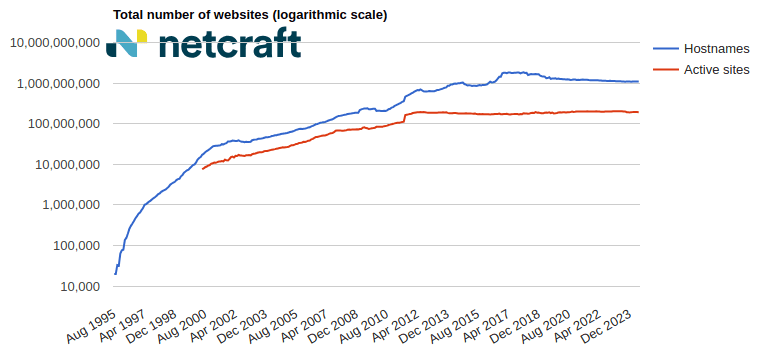
In the June 2024 survey we received responses from 1,101,431,853 sites across 269,118,919 domains and 12,865,432 web-facing computers. This reflects an increase of 4.0 million sites, an increase of 981,220 domains, and a decrease of 33,027 web-facing computers.
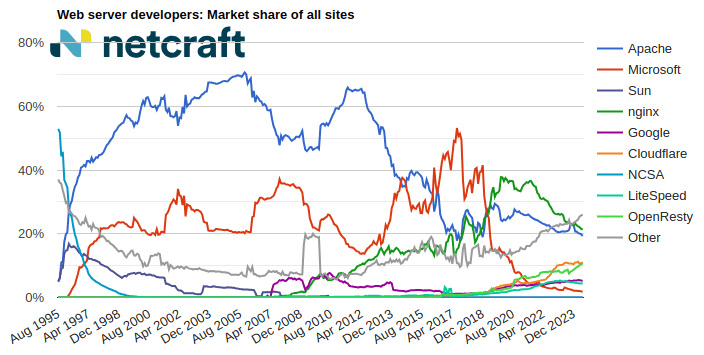
OpenResty experienced the largest gain of 4.6 million sites (+4.01%) this month, and now accounts for 10.8% (+0.38pp) of sites seen by Netcraft. Cloudflare made the next largest gain of 3.2 million sites (+2.66%).
Apache experienced the largest loss of 4.8 million sites (-2.23%) this month, reducing its market share to 19.3% (-0.51pp). LiteSpeed suffered the next largest loss, down by 1.1 million sites (-2.24%).
Vendor news
- njs 0.8.5 was released on June 25th, primarily containing bug fixes. Earlier this month its source code was moved to GitHub.
- freenginx 1.27.1 was released on June 4th. New features include support for limiting the number of headers in a HTTP request, and support for additional authentication mechanisms in its mail proxying module.
- LiteSpeed 6.3 was released on June 26th, containing new features, improvements, and bug fixes. The new features are mainly security-related.
- Apache Tomcat versions 9.0.90, 10.1.25, and 11.0.0-M21 were released.
- Amazon announced its plan to launch a new AWS region in Taipei, Taiwan by early 2025.
| Developer | May 2024 | Percent | June 2024 | Percent | Change |
|---|---|---|---|---|---|
| nginx | 236,239,936 | 21.53% | 235,170,823 | 21.35% | -0.18 |
| Apache | 217,239,604 | 19.80% | 212,402,611 | 19.28% | -0.51 |
| Cloudflare | 118,561,124 | 10.80% | 121,715,882 | 11.05% | 0.25 |
| OpenResty | 114,268,616 | 10.41% | 118,852,803 | 10.79% | 0.38 |
| Developer | May 2024 | Percent | June 2024 | Percent | Change |
|---|---|---|---|---|---|
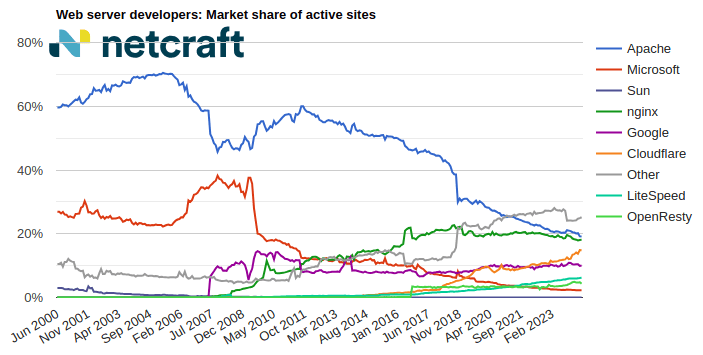
| Apache | 37,106,437 | 19.17% | 36,784,011 | 19.13% | -0.04 |
| nginx | 34,944,050 | 18.06% | 34,778,931 | 18.09% | 0.03 |
| Cloudflare | 28,767,697 | 14.86% | 28,457,465 | 14.80% | -0.07 |
| 19,116,508 | 9.88% | 19,253,340 | 10.01% | 0.14 |
For more information see Active Sites.
| Developer | May 2024 | Percent | June 2024 | Percent | Change |
|---|---|---|---|---|---|
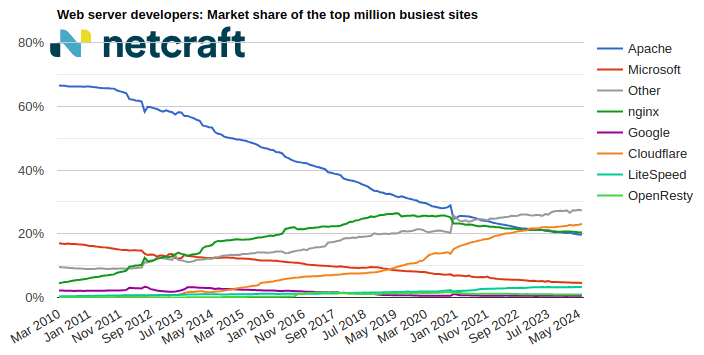
| Cloudflare | 228,120 | 22.81% | 230,996 | 23.10% | 0.29 |
| nginx | 204,238 | 20.42% | 205,005 | 20.50% | 0.08 |
| Apache | 197,994 | 19.80% |
…
 Organizing events that gather cybersecurity leaders requires significant effort and sponsorships. Unfortunately, some events and communities exclude CISOs who work for security vendors. This stance, though well-meaning, harms the industry and allows hidden conflicts of interest to go unchecked. Here’s why and how we can address this issue to improve such events and the community…
  Wherever you are in your professional journey, it helps to peek into another’s career story to learn from their approach, mistakes, and triumphs. In the following three videos, I reflect on my career so far to share my story, hoping that others in the industry will find it useful. Perhaps you’ll glean from these short…