AI Threats, Botnets, and Cloud Exploits Define This Week’s Cyber Risks
Weekly summary of Cybersecurity Insider newsletters
The post AI Threats, Botnets, and Cloud Exploits Define This Week’s Cyber Risks appeared first on eSecurity Planet.
More results...
Weekly summary of Cybersecurity Insider newsletters
The post AI Threats, Botnets, and Cloud Exploits Define This Week’s Cyber Risks appeared first on eSecurity Planet.
New START expires: The treaty limits on the world’s largest nuclear arsenals are gone. The 15-year-old New START treaty expired at midnight, the last vestige of an arms-control regime that reduced the combined nuclear stockpiles of Moscow and Washington from some 60,000 warheads to a few thousand.
Fears of nuclear proliferation. The evaporation of arms controls and the fading leadership of the United States have U.S. allies pondering nuclear-arms programs of their own, lawmakers and former U.S. officials said Wednesday on Capitol Hill.
“I am very concerned about the potential for proliferation, so-called friendly proliferation. I do not think it will be helpful to stability and security,” said Rose Gottemoeller, a former NATO deputy secretary general. “There are many, I would say, debates and discussions that have surprised us among our NATO allies.” Defense One’s Patrick Tucker has more from the Senate Armed Services Committee hearing, here.
U.S., Russia agree to resume high-level military-to-military dialogue. The United States broke off the relationship in late 2021, months before Russia broadened its invasion of Ukraine. The move follows meetings in UAE between Gen. Alexus G. Grynkewich, who leads U.S. European Command and is also NATO’s senior military commander, and senior Russian and Ukrainian military officials, according to a Thursday release from EUCOM.
Rewind: The two countries had maintained senior ties during and after the Cold War, and had even begun cooperating in military exercises—until Russia seized Crimea in 2014.
Ukraine struck a Russian missile-launch site in January. Ukrainian Flamingo missiles, and possibly other weapons, damaged hangar-type buildings used to prep intermediate-range and intercontinental ballistic missiles, Ukrainian officials posted to Telegram on Wednesday. Reuters could not immediately verify the statement independently, but has a bit more, here.
Wargaming invasion: Meanwhile, a tabletop simulation organized by a German newspaper and the country’s military suggests that the rest of Europe is far from ready to resist a Russian invasion. According to the Wall Street Journal, “The exercise simulating a Russian incursion into Lithuania, organized in December by Germany’s Die Welt newspaper together with the German Wargaming Center of the Helmut-Schmidt University of the German Armed Forces, became an object of heated conversation within Europe’s security establishment even before the newspaper published its results on Thursday.”
Why this matters: “A Russian incursion, or outright invasion, into countries of the North Atlantic Treaty Organization and the European Union has become more likely because of Europe’s tensions with President Trump over Greenland, Ukraine, trade and other matters, many European security and political leaders say.” Read more, here.
Welcome to this Thursday edition of The D Brief, a newsletter focused on developments affecting the future of U.S. national security, brought to you by Ben Watson with Bradley Peniston. It’s more important than ever to stay informed, so we’d like to take a moment to thank you for reading. Share your tips and feedback here. And if you’re not already subscribed, you can do that here. On this day in 1988, Panama’s military ruler Gen. Manuel Noriega was indicted in a U.S. court on drug smuggling and money laundering charges. The U.S. launched an invasion of Panama at the end of the year, leading to Noriega’s surrender and capture on Jan. 3, 1989.
U.S. and Iranian officials are set to talk Friday in Oman, though the outlook for those talks is dim, analysts at the Washington-based Institute for the Study of War said in their Wednesday analysis.
Differing goals: The U.S. side wants to discuss Iran’s nuclear and ballistic missile programs as well as its support for proxy groups across the region, but Iranian officials want to limit discussions to their nuclear program only.
Iranian officials seem to be signaling they are unafraid of a prolonged regional war should the U.S. military carry out additional attacks inside Iran, which is also a concern of White House officials, ISW writes.
And for what it’s worth, the Navy’s guided-missile destroyer USS Delbert D. Black departed port in Israel on Sunday, U.S. military officials said Thursday ahead of talks with Iranian officials in Oman.
The U.S. Navy has at least eight other vessels in the vicinity of Iran, including the USS Abraham Lincoln aircraft carrier. That’s according to open-source monitors sharing a regional map on social media Wednesday.
The U.S. fleet deployed to the Middle East is nearly as large as the one deployed near Venezuela, open-source tracker Ian Ellis observed online Monday. “The primary difference is 3x littoral combat ships (with mine countermeasures package) in the Middle East vs 3-ship Amphibious Ready Group + Marine Expeditionary Unit in Caribbean,” he said.
U.S. forces in the region attacked ISIS fighters with five recent strikes, Central Command officials said Wednesday. Targets included a “communication site, critical logistics node, and weapons storage facilities” via at least “50 precision munitions delivered by fixed-wing, rotary-wing, and unmanned aircraft,” CENTCOM said in a statement.
The U.S. and regional partners have killed or captured more than 50 alleged ISIS militants since mid-December. That includes a man named Bilal Hasan al-Jasim, who CENTCOM says was linked to a Dec. 13 attack that killed two U.S. troops and an interpreter at a Syrian base in Palmyra.
The White House is keeping 2,300 immigration officers in Minnesota, a city with just 600 police. Homeland Security officials sent 3,000 or so immigration agents to the city for their Operation Metro Surge crackdown, which began in December. But after their presence sparked protests and agents killed two Americans in the streets, President Trump’s “border czar” Tom Homan said Wednesday 700 agents would leave the city soon.
Their outsized presence still raises questions about why Minnesota, a state with an estimated 130,000 undocumented immigrants, was the administration’s first choice for an agent presence so large and out of proportion to local police—especially when Florida and Texas are estimated to have undocumented immigrant populations orders of magnitude larger with 1.6 million in Florida and 2.1 million in Texas, according to a 2023 report from the Pew Research Center.
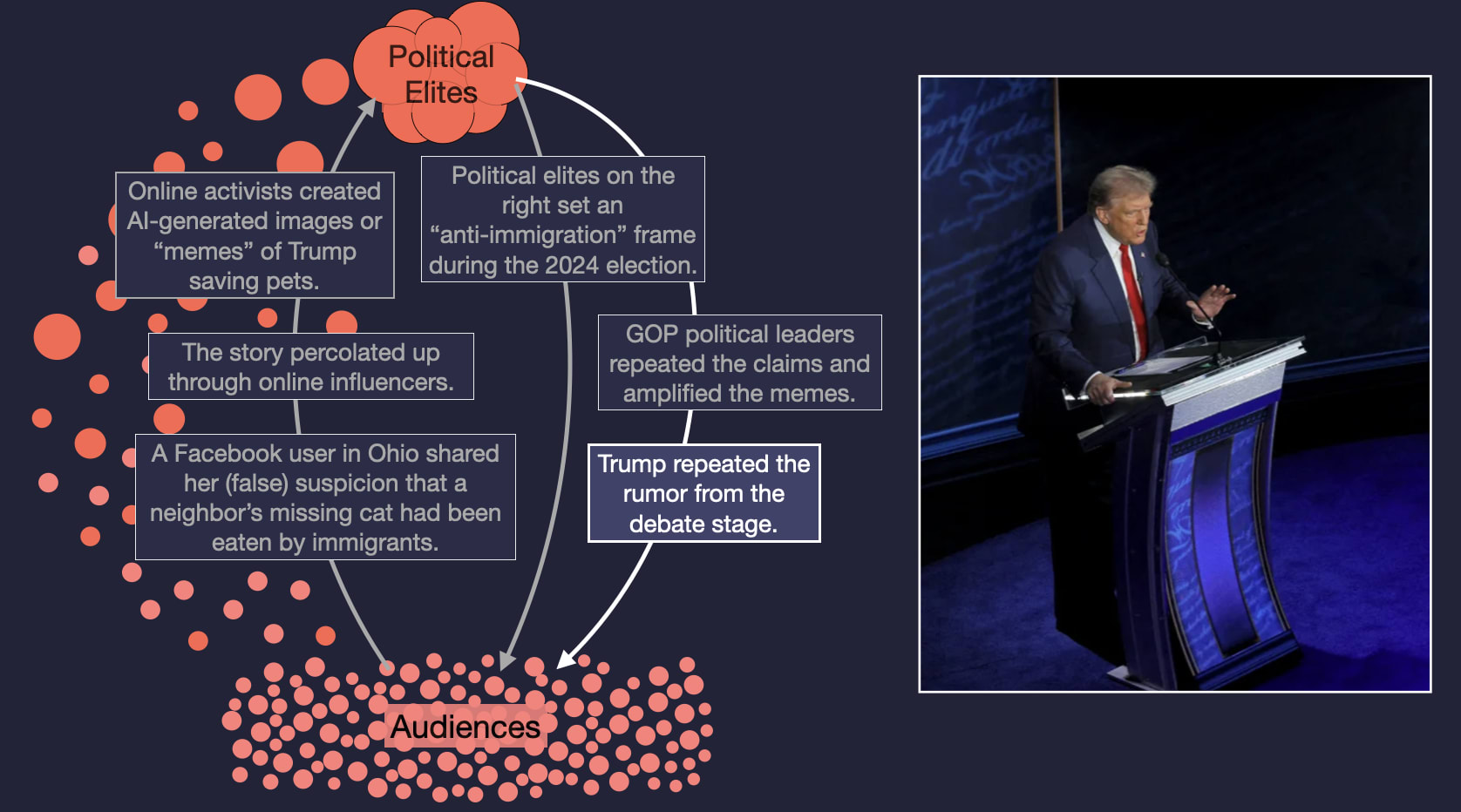
The White House claims fraud allegations from a debunked video about Somali-American daycare centers are a large part of what drew their attention to Minnesota. That video went viral on right-wing networks in December; most immigration agents arrived in early January. It makes little difference to the administration and its online supporters that many of their claims about immigrants are not true (Haitian-Americans eating pets, e.g.), or that dozens of initial allegations by administration officials have fallen apart in court—including their prosecution of school teacher Marimar Martinez, who was shot five times in Chicago last October. DHS officials later claimed she was a “domestic terrorist” who “ambushed” them with her car.
After Martinez’s attorney challenged the evidence, the case fell apart and the administration asked the court to dismiss the charges with prejudice so they can’t be filed again. (She detailed that case Tuesday before members of Congress in Washington.)
But that didn’t stop Supreme Court Justice Samuel Alito from repeating the administration’s false portrayal of the Martinez case in his dissenting opinion for Trump v. Illinois, the late-December SCOTUS case blocking Trump National Guard deployment in Chicago.
Others see an administration trying to impose its will on a state and region that did not vote for Trump in recent elections. David French argued that case last week in the New York Times. Indeed, Trump’s top immigration advisor Stephen Miller wrote online Sunday that he believes Democrats in Minnesota “after losing an election, launched an armed resistance to stop the federal government from reversing the invasion.”
To that end, “ICE has likely violated more court orders in January 2026 than some federal agencies have violated in their entire existence,” the chief judge for the U.S. District Court of Minnesota said in a decision released last week. In that document, the judge cataloged a total of 96 court orders that he said ICE had violated in 74 different cases.
Former DHS official Paul Rosenzweig has some ideas for how to reform ICE, and they begin with training and recruitment changes, he wrote Wednesday in The Atlantic. Rosenzweig, a former DHS deputy assistant secretary for policy from 2005 to 2009, recommends bumping the minimum age back up to 21 and adding “enhanced training on constitutional law, while significantly reducing its emphasis on SWAT-like uses of force.” He also advises dropping “broad sweeps in urban environments” and opting instead “for targeted enforcement against identified subjects.” However, such changes “will require immense political capital and lots of hard work,” he admits. Read more (gift link), here.
Additional reading: “The Real Story Behind the Midnight Immigration Raid on a Chicago Apartment Building,” via ProPublica reporting Wednesday from still more inaccurate claims from the White House that later evaporated upon closer inspection.
In case you missed it, a judge appears to be skeptical of Pentagon chief Pete Hegseth’s effort to demote former astronaut and retired Navy Capt. Sen. Mark Kelly, D-Arizona, the Washington Post reported Wednesday. Kelly had joined other lawmakers in a video this fall warning troops against following illegal orders, which is a warning Hegseth himself issued 10 years ago before working in the Trump administration. “Our laws are clear. You can refuse illegal orders,” Kelly said in the video.
Trump responded angrily, and said on social media Kelly’s message amounted to “SEDITIOUS BEHAVIOUR, punishable by DEATH.”
Hegseth responded with a formal letter of censure for Kelly and claimed the lawmaker had “undermined the chain of command,” “counseled disobedience” and displayed “conduct unbecoming an officer.” He also launched disciplinary proceedings to reduce Kelly’s rank and retirement benefits.
But: “That’s never been done before,” U.S. District Judge Richard J. Leon said at a hearing on the matter Tuesday. “You’re asking me to do something the Supreme Court’s never done,” Leon added, and later said he intends to rule on the matter by next Wednesday. He also said he expects his ruling to be appealed.
“Today was a day in court, not just for my constitutional rights, but for millions of retired service members, and really all Americans,” Kelly told reporters at the hearing this week. “There’s nothing more fundamental to our democracy than the freedom of speech and the freedom to speak out about our government.” More, here.
]]>
Fading U.S. leadership has countries from Poland to South Korea thinking about nuclear-weapons programs of their own.
A U.S. F-35 shot down an Iranian drone on Tuesday: a Shahed-139 that was flying toward the carrier Abraham Lincoln in the Arabian Sea, military officials told Reuters. The Shahed-139 is a medium-altitude long-endurance UAV that looks a lot like a MQ-1B Predator; The Aviationist reports that it can be equipped for surveillance missions, or armed to strike.
A U.S.-flagged oil tanker also outran Iranian gunboats Tuesday in the Strait of Hormuz, the Wall Street Journal reported.
Context: “The downing of the drone comes at a moment of heightened tension in the region, as the U.S. military builds up forces for a possible confrontation with Iran,” the New York Times reports. “Last month, President Trump threatened to attack the country after its government brutally crushed anti-government protests that began in late December.”
Trump has since “shifted his focus to demanding a deal that would end Iran’s nuclear program and its support for proxy groups in the Middle East, such as Hamas, Hezbollah and the Houthis operating in Yemen,” the Times writes. “Talks between Iran’s foreign minister, Abbas Araghchi; Steve Witkoff, Mr. Trump’s Middle East envoy; and Jared Kushner, the president’s son-in-law, are scheduled to take place in Istanbul this week. But regional officials and diplomats have described the plans for the negotiations as tenuous.”
Satellite imagery shows the U.S. military buildup, as the Washington Post lays out, here. But at least one component was missing—at least as of Sunday, the Journal reports. “American airstrikes on Iran aren’t imminent, U.S. officials say, because the Pentagon is moving in additional air defenses to better protect Israel, Arab allies and American forces in the event of a retaliation by Iran and a potential prolonged conflict.” Read on, here.
The Pentagon announced nearly $20 billion in Middle Eastern arms sales since Friday. That includes $12 billion from the Saudis for 730 PAC-3 missiles and F-15 aircraft servicing; and $7 billion from Israel for more than 3,000 Joint Light Tactical Vehicles, 30 Apaches, AW-119Kx light utility helicopters, and Rolls Royce power packs for armored personnel carriers.
The sales come amid a shaky ceasefire for Gaza, where “big challenges await in its next phases, including the deployment of an international security force to supervise the deal and the difficult process of disarming Hamas,” the Associated Press reported Friday.
Update: Democratic lawmakers warn the Trump family has allegedly taken a “bribe” from UAE officials, Senate Foreign Relations Committee members said in a statement Tuesday after the development surfaced in Wall Street Journal reporting Saturday.
Recap: Emirati Sheikh Tahnoon bin Zayed Al Nahyan secretly purchased a major stake in a Trump-family cryptocurrency venture called World Liberty Financial four days before President Trump’s inauguration. A few months later, the White House approved the sale of advanced U.S. artificial intelligence chips for the UAE.
“Trump appears to have been enriching his own family to the tune of hundreds of millions of dollars through secretive deals with foreign power brokers who have significant business before the U.S. government,” the lawmakers said in their statement. “That is not public service—it is a pay-to-play scheme that puts personal profit ahead of the national interest.”
“The national security implications are just as alarming” as this development follows years of warnings about sensitive U.S. technology “flowing through the UAE and ultimately ending up in China,” the group of lawmakers said. That group includes Maryland’s Chris Van Hollen, Nevada’s Jacky Rosen, Chris Coons of Delaware, Connecticut’s Chris Murphy, Cory Booker of New Jersey, Hawaii’s Brian Schatz, Virginia’s Tim Kaine, Jeff Merkley of Oregon and Tammy Duckworth of Illinois. In response, they promised to “use every tool at our disposal now—and when we are in the majority— to bring full transparency and accountability to the American people.”
In other international arms developments, Pakistan is fielding growing interest in its JF-17 fighter jet following its skirmish last year with India, Bloomberg reported Tuesday. However, “That sudden demand may put the country’s defense industry in a crunch.”
Commentary: The U.S. should deepen its defense-industrial ties with Pakistan, argues Joe Buccino in an oped for Defense One. Buccino, a retired Army colonel, formerly served as CENTCOM spokesman.
For what it’s worth: The Vietnamese military is preparing for a possible American “war of aggression” amid tensions with China as the U.S. is now viewed as a “belligerent” power, AP reported Tuesday from Hanoi. According to an internal document obtained by a human rights organization, “due to the U.S.’s belligerent nature we need to be vigilant to prevent the U.S. and its allies from ‘creating a pretext’ to launch an invasion of our country,” Vietnamese military planners warned. Read more, here.
And don’t miss Tom Nichols’ warning about “The End of the Nuclear-Arms-Control Era,” with the expiration Thursday of the New START treaty between the U.S. and Russia. The agreement capped long-range missiles and bombers, but Trump said last month he was not concerned. “If it expires, it expires,” he told the New York Times.
Coverage continues below…
Welcome to this Wednesday edition of The D Brief, a newsletter focused on developments affecting the future of U.S. national security, brought to you by Ben Watson with Bradley Peniston. It’s more important than ever to stay informed, so we’d like to take a moment to thank you for reading. Share your tips and feedback here. And if you’re not already subscribed, you can do that here. On this day in 1992, Hugo Chávez led a failed coup d’état against Venezuelan President Carlos Andrés Pérez.
Twenty-five defense firms have been invited to the Pentagon’s one-way attack drone competition later this month at the Army’s base in Fort Benning, Georgia.
The U.S. military wants to spend more than a billion dollars over four phases of development as part of its Drone Dominance Program. That effort aims to replicate the cheap and effective drones produced by Iran, which has exported the technology to Russia as part of its ongoing invasion and occupation of Ukraine. The U.S. military wants to begin “fielding hundreds of thousands of weaponized, one way attack drones ready for combat” by 2027, the Pentagon said Tuesday.
Review the 25 vendors participating in the first phase of the competition, known as the Gauntlet, here.
Culture wars update: Defense Secretary Pete Hegseth’s office is now threatening a children’s organization. That threat this week was directed at the leadership of Scouting America for allowing girls to join after changing its name from the “Boy Scouts” in 2024, the Washington Post reported Tuesday—following up on a proposal NBC News first reported in April. Hegseth’s spokesman Sean Parnell issued his warning Monday night in a statement posted to social media.
“For more than a decade now, Scouting America’s leadership has made decisions that run counter to the values of this administration” and the Defense Department, “including an embrace of [diversity, equity, inclusiveness] and other social justice, gender-fluid ideological stances. This is unacceptable,” Parnell declared. “Scouting America and the Department of War are near a final agreement,” he said “as long as the organization rapidly implements the common-sense, core value reforms.” The largest impact seems to be the organization’s National Jamboree celebration, “a massive 10-day summit scheduled for July and expected to draw more than 15,000 Scouts from throughout the country to West Virginia,” the Post reports. “In the past, upward of 500 National Guard personnel, military reservists and active-duty service members have provided a range of equipment and logistical support for the event—all now in doubt if the organization does not meet the Pentagon’s demands.”
“They are on the clock, and we are watching,” Parnell warned in his note Monday night on Elon Musk’s social media platform X.
Reminder: The Pentagon is using Elon Musk’s Grok AI chatbot, which has been producing sexualized images of people and children even when instructed that subjects do not consent, Reuters reported Tuesday.
By the way: Elon Musk’s X offices were raided in France this week as prosecutors investigate child abuse images produced by Grok, AP reported Tuesday. French prosecutors “also said both Musk and former X chief executive Linda Yaccarino had been summoned to appear at hearings in April,” the BBC reports. British officials also announced a probe into Grok regarding its “potential to produce harmful sexualised image and video content.”
Musk has called the investigations a “political attack” and an effort “to suppress free speech.”
But French officials strongly disagreed, and replied directly to Musk on Tuesday, “Investigating child sexual abuse material isn’t controversial. Turning it into political theater is manipulation. Maybe that logic flies on some island. Doesn’t fly in France.”
Related reading:
After immigration agents drew their weapons on observers and arrested them in Minneapolis Tuesday, New York’s attorney general launched an official “observation project” to monitor federal immigration enforcement in the state of New York.
Background: “A federal judge last month put limits on how officers treat motorists who are following them but not obstructing their operations,” AP reports. Safely following agents “at an appropriate distance does not, by itself, create reasonable suspicion to justify a vehicle stop,” the judge wrote in the order. But it was later appealed and set aside temporarily, which is contributing to the scenes filmed Tuesday in Minneapolis and elsewhere around the state last week.
Get to better know Immigration and Customs Enforcement’s troops from BORTAC and SRT, which WIRED calls “paramilitary tactical units [that] behave not like local police, but instead like special forces in Iraq, Afghanistan.” Personnel from those two units are reportedly the ones who killed American citizens Renee Good and Alex Pretti last month.
Why it matters: “The brutal tactics of SRT and BORTAC units seem to have spread into ICE and CBP as a whole,” WIRED’s Ali Winston writes.
Expert reax: “These teams are our equivalent of special operations command,” said Gil Kerlikowske, a former CBP commissioner from 2014 through 2017. “BORTAC in particular is used to operating in the desert. They are not trained for urban policing. They’re absolutely the wrong tool for the job. It’s like using a chain saw to mow your lawn.” Read more, here.
“We have seen in Minnesota how quickly and tragically federal operations can escalate in the absence of transparency and accountability,” New York Attorney General Letitia James said Tuesday while announcing the new Legal Observation Project. The idea is “to examine federal enforcement activity in New York and whether it remains within the bounds of the law,” she said.
Purple vests: “When necessary, OAG will send teams of legal observers to the location of reported immigration enforcement activity, outfitted in easily identifiable, purple OAG-branded safety vests, to witness and document enforcement actions,” James said. “Observers will not interfere with enforcement activity; their role is solely to document federal conduct in a safe and lawful manner.”
Her office also launched a “secure online portal” for sharing video of ICE arrests and encounters, which can later be reviewed for compliance with the law. More, here.
ICE agents left “death cards” in arrested immigrants’ cars in Colorado, so six state lawmakers are calling for an investigation into the matter. “The ICE-branded ace of spades cards, similar to the ‘death cards’ left on corpses by U.S. forces during the Vietnam War, were stamped with ‘ICE Denver field office’ and the address and phone number for the immigration detention center in Aurora,” the Denver Post reported Tuesday.
“The ‘death cards’ have a history of being used by white supremacist groups to intimidate people of color,” the six lawmakers wrote to the Department of Homeland Security Office of Inspector General in a letter Tuesday. “This behavior undermines public trust in law enforcement, raises serious civil rights concerns, and falls far short of the professional standards expected of federal agents,” they added.
Texas National Guard members are wearing civilian clothes while “embedded” at immigration detention facilities in Texas, Democratic Rep. Joaquin Castro said Monday on Facebook after personally visiting the facilities.
The soldiers are there on state Gov. Greg Abbott’s orders. “He has forced the Texas National Guard to do deportation work at these detention centers. So the Texas National Guard is not in their uniforms,” Castro said. “They’re basically camouflaged as civilians in these detention centers.” The San Antonio Express-News has more.
Also: A new study shows how “The U.S. immigrant population generated more in taxes than they received in benefits from all levels of government every year from 1994 to 2023.” That’s according to a new analysis published Tuesday by the libertarian Cato Institute. Additional takeaways include:
What’s more, those estimates “represent the lower bound of the positive fiscal effects. Even by this conservative analysis, immigrants may have already prevented a fiscal crisis,” the study’s authors write. Details here.
And lastly today: DHS has begun targeting citizens critical of the administration using a secretive legal weapon known as an administrative subpoena, the Washington Post reported Tuesday.
It’s a tool for digital surveillance and review that “federal agencies can issue without an order from a judge or grand jury,” and it’s now being “weaponized…to strangle free speech,” the Post’s John Woodrow Cox reported from Philadelphia in the case of a 67-year-old who wrote to DHS in defense of an Afghan immigrant facing deportation.
Expert reax: “There’s no oversight ahead of time, and there’s no ramifications for having abused it after the fact,” said Jennifer Granick of the American Civil Liberties Union. “As we are increasingly in a world where unmasking critics is important to the administration, this type of legal process is ripe for that kind of abuse.” Read the full story (paywall alert), here.
]]>
Global Threat Map is an open-source project offering security teams a live view of reported cyber activity across the globe, pulling together open data feeds into a single interactive map. It visualizes indicators such as malware distribution, phishing…
American munitions makers are working to increase production capacity. Although Congress didn’t much bend to the White House’s last-minute request for a munitions-funding boost, defense executives say it’s enough to persuade them to pour more of their own funds into boosting production, Defense One’s Lauren C. Williams and Thomas Novelly reported Monday.
“We’ve been getting the demand signals from the customer set long before now, whether that’s the amount of munitions that have been expended around the world, or just the stock of ammunition,” said Rylan Harris, who leads business development for Northrop Grumman’s armament systems business unit. “We’ve been seeing those demand signals already, which has helped us focus a lot of our investments in increasing capacity.” Read on, here.
Related: South Korea’s Hanwha Defense USA announced last week that it will spend $1.3 billion to build a factory at the Pine Bluff Arsenal in Arkansas to make ingredients for explosives, propellants, and munitions.
Mississippi Sen. Roger Wicker, chair of the Armed Services Committee, praised the development. “We need to bring new entrants into the American defense industrial base to increase competition and guard against single sources of supply, particularly on key programs like energetics and munitions. This agreement demonstrates how smart partnerships with allies can expand production against our mutual adversaries while reinforcing our domestic industrial base,” Wicker said in a statement Monday.
DOD launches science-and-innovation board as the U.S. cuts research. The new Science, Technology, and Innovation Board, which is a merger of the decade-old Defense Innovation Board and the 70-year-old Defense Science Board, is meant to “streamline” the department’s approach to the hardest technological and scientific national-security challenges. But it comes on the heels of Trump-administration cuts that could hinder those efforts. Defense One’s Patrick Tucker reports. Story, here.
Additional industry reading:
Welcome to this Tuesday edition of The D Brief, a newsletter focused on developments affecting the future of U.S. national security, brought to you by Ben Watson with Bradley Peniston. It’s more important than ever to stay informed, so we’d like to take a moment to thank you for reading. Share your tips and feedback here. And if you’re not already subscribed, you can do that here. On this day in 1917, the U.S. broke off diplomatic relations with Germany, which had announced a turn to unrestricted submarine warfare around the British Isles.
New: Despite months of pleading by far-right influencers and Fox pundits, the U.S. military won’t send active-duty troops to Minnesota after all, the New York Times reported Monday. Airborne soldiers in Alaska and military police in North Carolina had been put on standby to deploy during aggressive ICE raids throughout Minneapolis last month, which triggered weeks of voluminous demonstrations from locals.
Trump threatened to invoke the Insurrection Act amid the unrest. But after the deaths of two American citizens at the hands of immigration agents on Jan. 7 and 24, the U.S. military’s Northern Command “quietly ordered the active-duty troops on standby to stand down,” a U.S. official told the Times.
In Oregon, a 53-year-old man was arrested after asking people at gunpoint if they’re a U.S. citizen. Among other actions along Interstate 5, he reportedly triggered a series of accidents before he was taken into custody by police on Thursday.
He shot at one victim. “That first shooting reportedly set off a series of crimes in which [the assailant] asked about another victim’s national loyalties, switched lanes and directions on the freeway, crashed into at least one victim’s vehicle and tried to steal a series of vehicles—including an ambulance that was responding to the scene,” the Roseburg, Oregon, News Review reported Monday. “No one was injured by the shooting, although at least one alleged victim was treated” at a local hospital for injuries from the collision.
Related reading:
A whistleblower complaint alleging wrongdoing by Trump’s intelligence chief has been “stalled” for months, the Wall Street Journal reported Monday. It’s reportedly “locked in a safe” somewhere because it concerns Director of National Intelligence Tulsi Gabbard, and its disclosure could cause “grave damage to national security,” according to an official.
“The complaint was filed last May with the intelligence community’s inspector general, according to a November letter that the whistleblower’s lawyer addressed to Gabbard,” the Journal reports, two months after lawmakers were told about the broad contours of the case. That November letter “accused Gabbard’s office of hindering the dissemination of the complaint to lawmakers by failing to provide necessary security guidance on how to do so.”
The complaint itself is reportedly “so highly classified that [the whistleblower’s attorney] said he hasn’t been able to view it himself.” A spokesman for Gabbard called the complaint “baseless and politically motivated.” As for the delay, the Journal reports “A representative for the inspector general said the office had determined specific allegations against Gabbard weren’t credible, while it couldn’t reach a determination on others.”
It’s unclear exactly why the process has stalled for nine months, especially since sensitive facilities for sharing classified intelligence—SCIFs—have been available in Washington for decades. Experts called the delay unprecedented and noted the intelligence community’s “inspector general is generally required to assess whether the complaint is credible within two weeks of receiving it, and share it with lawmakers within another week if it determines it is credible.” That would have been nearly eight months ago.
But Gabbard had time to visit Atlanta after an FBI raid on an election center last week, where Trump spoke directly to agents through Gabbard’s phone after they seized ballots from the 2020 election, the New York Times reported Monday.
The raid was “extraordinary,” but the phone call “was even further outside the bounds of normal law enforcement procedure” and “a major departure from past practice,” the Times reports. That’s because “Rather than going to senior department or F.B.I. officials, Mr. Trump spoke directly to the frontline agents doing the granular work of a politically sensitive investigation in which he has a large personal stake.”
Expert reax: “The DNI’s job is intelligence, not domestic law enforcement and Gabbard’s insertion into a federal criminal matter is virtually certain to be in violation of the law,” said Joyce Vance, former U.S. Attorney for the Northern District of Alabama.
One possible consequence: Trump’s “conversation with the agents would probably become part of an effort to have the case dismissed as a vindictive prosecution.”
Experts are also concerned Trump may be planning “to contest the results of this year’s congressional midterms,” the Times reports. Trump fanned the flames of that potential constitutional crisis Monday when he suggested on former FBI Deputy Director Dan Bongino’s podcast “we should take over the voting in at least 15 places” and “Republicans ought to nationalize the voting.”
Trump also repeated his conspiratorial, unsupported claims that he won the 2020 election in his conversation Monday with Bongino. “We have states that are so crooked, and they’re counting votes—we have states that I won that show I didn’t win. Now you’re going to see something in Georgia where they were able to get with a court order, the ballots, you’re going to see some interesting things,” Trump said. (Politico and NBC News have more.)
Worth noting: “Multiple prior investigations—including one at the end of Mr. Trump’s first term by the same F.B.I. office and federal prosecutors working at the time for the Trump-appointed U.S. attorney in Atlanta—found no evidence to support his false claims of significant voter fraud,” the Times added to the bottom of their report about Gabbard’s appearance in Atlanta last week.
In still more conflict-of-interest reporting, top UAE officials bought a “secret stake” in Trump’s “fledgling cryptocurrency venture for half a billion dollars” just four days before Trump’s inauguration last January, the Wall Street Journal reported Saturday. “The deal with World Liberty Financial, which hasn’t previously been reported, was signed by Eric Trump, the president’s son.”
But just a few months later, “the administration committed to give the tiny Gulf monarchy access to around 500,000 of the most advanced AI chips a year—enough to build one of the world’s biggest AI data center clusters…The agreement was widely viewed as a coup for the emirate’s ruling family, overcoming longstanding U.S. national security concerns and allowing the country to compete with the most powerful economies in the world at the cutting edge of AI advances.”
But no one had yet publicly known the UAE bought that secret stake on Jan. 16, giving them 49% ownership of Trump’s crypto firm. And as part of that deal, “At least $31 million was also slated to flow to entities affiliated with the family of Steve Witkoff, a World Liberty co-founder who weeks earlier had been named U.S. envoy to the Middle East, the documents said.”
The deal is “unprecedented in American politics: a foreign government official taking a major ownership stake in an incoming U.S. president’s company,” the Journal writes.
Why it matters: “Trump family businesses made $187 MILLION from this deal, and just months later he gave the UAE some of our most top-secret AI tech,” Maryland Democratic Sen. Chris Van Hollen said in a statement. “They are selling our national security to the highest bidder,” he said. “Foreign countries are bribing our president to sell out the American people.”
Former White House ethics lawyer Ian Bassin: “I used to advise people not to even accept a free cup of coffee from someone who had interests before them. And staff followed those rules. I can’t even find the words to describe the scale of Trump’s corruption here.”
Developing: Cuba may have only two to three weeks of oil left as Trump works to implement more regime change in the region with another oil blockade, the Financial Times reported Monday.
Recall that the White House is hoping to topple Cuba’s leaders by the end of the year, officials recently told the Wall Street Journal. That accounts for the pressure Trump has put on Mexico to halt oil shipments to Cuba, “which it supplied in exchange for medical services from Cuban doctors,” as the Times reported Saturday. Those stopped in early January. Trump signed an executive order last week promising tariffs on any nation that sells oil to Cuba. The Associated Press has a tiny bit more on these developments, reporting Sunday from Air Force One, here.
From the ruins of America’s failed invasions in Iraq and Afghanistan, Trump’s Venezuela oil plans are following a few legal precedents and creative workarounds learned during those conflicts, argue former State Department counsel Scott Anderson and former Treasury Department official Alex Zerden, writing Monday in Lawfare.
After some lengthy rehashing of State Secretary Marco Rubio’s testimony last week before the senate, which we flagged in Thursday’s newsletter, Anderson and Zerden write this in summary: “At its highest level, the contours of the Trump administration’s policy towards Venezuelan assets follow a familiar and reasonable policy logic,” however Trump’s “shameful record of self-enrichment” makes close “scrutiny all the more important, as there is still room in these arrangements for genuine corruption.”
Analysis: When it comes to Trump’s foreign policy, the president can best be described as a “Predatory Hegemon,” argues Harvard’s Stephen Walt, writing Tuesday in Foreign Affairs. Here’s a loose outline of his argument:
There are many examples of this throughout history, Walt argues. For example, “The desire to extract wealth from colonial possessions was a central ingredient in the Belgian, British, French, Portuguese, and Spanish colonial empires, and similar motives influenced Nazi Germany’s one-sided economic relations with its trading partners in central and eastern Europe and the Soviet Union’s relations with its Warsaw Pact allies.”
The big problem, he argues: “This strategy is not a coherent, well-thought-out response to the return of multipolarity; in fact, it is exactly the wrong way to act in a world of several great powers” because “predatory hegemony contains the seeds of its own destruction.” After flagging several inflated and inaccurate claims by Trump, Walt warns in closing, “To be sure, the United States is not about to face a vast countervailing coalition or lose its independence—it is too strong and favorably positioned to suffer that fate. It will, however, become poorer, less secure, and less influential than it has been for most living Americans’ lifetimes.” Continue reading, here.
By the way, here’s Trump speaking at a black-tie event Saturday for a club that began meeting in 1913 to celebrate the birthday of the legendarily treasonous Army Gen. Robert E. Lee: “We’re not going to invade Greenland. We’re going to buy it,” Trump told the meeting of CEOs known as the Alfalfa Club, according to the Washington Post.
“It’s never been my intention to make Greenland the 51st state. I want to make Canada the 51st state. Greenland will be the 52nd state. Venezuela can be 53rd,” Trump said.
Additional reading: “Judge calls Justice Department’s statements on slavery exhibit display ‘dangerous’ and ‘horrifying,’” the Associated Press reported Saturday from Philadelphia.
]]>
Shutdown begins as Congress hopes to keep duration minimal. The Senate on Friday evening approved a spending package that ensures nearly all agencies are funded through fiscal 2026, but the agreement came too late to stave off an appropriations lapse, Eric Katz of Government Executive reports.
With House lawmakers in recess until today, funding cannot be restored until the afternoon at the earliest. But that vote isn’t expected until at least Tuesday, according to The Hill and Reuters.
Recap: Senate Democrats and the White House came to an agreement late Thursday to fund the vast majority of federal agencies, while providing a two-week stopgap continuing resolution to the Homeland Security Department. Democrats want more restrictions placed on DHS’s immigration enforcement as part of that agency’s funding bill.
Possible DHS reforms include the removal of masks by federal law enforcement personnel, mandated use of body cameras, a requirement for third-party warrants to enter homes, the end of roving patrols in metropolitan areas by Immigration and Customs Enforcement and more uniform restrictions on use of force by federal agents. Democrats plan to negotiate over those items with the White House while the two-week DHS continuing resolution is in effect.
“Border czar” Homan’s rhetoric of war. Top Border Patrol official Tom Homan said there are still “around 3,000” immigration agents with either ICE or CBP in Minnesota. “They’ve been in theater—some of these people have been in theater for eight months,” Homan said at a press conference Friday. “So there’s going to be rotations of personnel. Hopefully less now that we have some agreements, maybe we can make it more efficient and safe. But they’ve been in theater a long time.”
Homan also said he hopes immigration agents don’t kill anymore people in Minnesota. “The President, one of the words he said to me, I came up here, he said he didn’t want to see anybody die,” he told reporters. “The less interference, the less rhetoric,” he said. “I buried ICE agents throughout my career, and the saddest thing I’ve ever done is hand a folded flag to a wife or a child. I don’t want to see anybody die. Even the people we’re looking for. I don’t want to see anybody die.”
“When we go find that bad guy, when we find that bad guy, many times it’s with others,” Homan said. “But we’re going to enforce immigration law…We’re going to do target enforcement operations and we’re going to prioritize the public-safety threats and national-security threats. That is what we’re here to do.”
Update: ProPublica has ID’d the two immigration agents who killed VA nurse Alex Pretti nine days ago. Their names are Jesus Ochoa, 43, and Raymundo Gutierrez, 35.
Why name these agents? “We believe there are few investigations that deserve more sunlight and public scrutiny than this one, in which two masked agents fired 10 shots at Pretti as he lay on the ground after being pepper-sprayed,” the news outlet said in an editor’s note. “The Department of Justice said it is investigating the incident, but the names of the two agents have been withheld from Congress and from state and local law enforcement.”
“The policy of shielding officers’ identities, particularly after a public shooting, is a stark departure from standard law enforcement protocols,” ProPublica said, citing lawmakers, state attorneys general, and former federal officials in this break from precedent. “Such secrecy, in our view, deprives the public of the most fundamental tool for accountability.” Story, here.
ICE agents in Minnesota ran a woman from Ecuador off the road, causing her to crash, and “in the course of her arrest” hurt her enough that she required seven days in the hospital. Politico’s Kyle Cheney flagged that development on social media Sunday.
In a separate encounter some likened to actions of a drug cartel, immigration agents tracked down an observer in her car, raced ahead of it in three unmarked cars and then stopped suddenly before jumping out and surrounding her vehicle with their guns drawn just outside of St. Peter, Minn., on Thursday. The scene was recorded on the U.S. citizen’s dash camera and shared with Minnesota Public Radio, which posted it to YouTube.
They opened her car door, dragged her out and handcuffed her on the ground before putting her in their vehicle and driving off. They traveled about 20 minutes before one of the agents received a phone call, and they exited the freeway and dropped her at the St. Peter police station. The police chief then “spoke with her, had her get into his squad car, and took her home,” MPR reports. Homeland Security officials put out a statement two days later calling the woman an “agitator” who ran stop signs while allegedly “stalking and obstructing law enforcement.”
Another Border Patrol agent was found drunk in his car and covered in vomit early Tuesday morning in St. Paul. After failing a sobriety test, he was later arrested and charged with 3rd and 4th degree driving while impaired, a local outlet, the Sahan Journal, reported Thursday.
A judge in Texas sharply criticized federal officials and agents when ordering the release of asylum seeker Adrian Conejo Arias and his five-year-old son Liam this weekend. Both were detained earlier this month in Minnesota when agents detained Liam and used him as bait to arrest his father as well.
“Observing human behavior confirms that for some among us, the perfidious lust for unbridled power and the imposition of cruelty in its quest know no bounds and are bereft of human decency. And the rule of law be damned,” the judge wrote in the order.
Welcome to this Monday edition of The D Brief, a newsletter focused on developments affecting the future of U.S. national security, brought to you by Ben Watson with Bradley Peniston. It’s more important than ever to stay informed, so we’d like to take a moment to thank you for reading. Share your tips and feedback here. And if you’re not already subscribed, you can do that here. On this day in 1943, German forces surrendered at Stalingrad, ending a battle that broke the Wehrmacht’s offensive capability. Total Nazi and Soviet casualties are estimated at 2 million and up.
Federal agents now have even broader power to arrest people without a warrant, according to an internal ICE memo the New York Times obtained late last week. The updated directive “centers on a federal law that empowers agents to make warrantless arrests of people they believe are undocumented immigrants, if they are ‘likely to escape’ before an arrest warrant can be obtained.”
Previously similar conditions had been applied to those allegedly posing a “flight risk,” but now they’re much wider—which would seem to make “the general premise of ever getting a warrant pointless,” one expert told the Times.
ICE agents surrounded another American in her car, broke her window, pulled her out and gave her a concussion, bruised ribs and a torn rotator cuff during a violent encounter Thursday in Salem, Oregon. Her local union said she was running errands when she was assaulted by four federal agents who demanded her “paper” while she was driving alone in Salem.
“The agents emptied her purse, discovered her passport, then left Maria there without seeking medical attention for her,” the union said in a statement Saturday. After the encounter, she called the police, who told her she should call the FBI since federal agents were the ones who assaulted her. The Salem Reporter has a bit more. Meanwhile to the south in Eugene, “protesters broke windows and tried to get inside the Federal Building near downtown” on Friday, the Associated Press reports. “City police declared a riot and ordered the crowd to disperse.”
Portland’s mayor is demanding ICE leave the Oregon city after agents fired rubber bullets, pepper balls and tear gas at demonstrators, including children, at a Saturday protest the mayor described as peaceful. “Federal forces deployed heavy waves of chemical munitions, impacting a peaceful daytime protest where the vast majority of those present violated no laws, made no threat, and posed no danger to federal forces,” Mayor Keith Wilson said in a statement Saturday evening.
“To those who continue to work for ICE: Resign. To those who control this facility: Leave,” the mayor said. “Through your use of violence and the trampling of the Constitution, you have lost all legitimacy and replaced it with shame,” he added. He also said the city is “moving swiftly to operationalize an ordinance that went into effect this month, imposing a fee on detention facilities that use chemical agents. As we prepare to put that law into action, we are also documenting today’s events and preserving evidence. The federal government must, and will, be held accountable.”
Bigger picture: “It appears the crime rate of CBP agents and offices was higher PER CAPITA than the crime rate of undocumented immigrants,” journalist Garrett Graff testified Friday after reviewing decades of public data as part of Illinois Governor J.B. Pritzker’s Illinois Accountability Commission. Over the last decade, the arrest rate alone for CBP officers and agents (.5%) is higher than the arrest rate of undocumented immigrants in the United States (.4%), according to data from the National Institute of Justice.
“Criminality is so rampant inside CBP that it has seen one of its own agents or officers arrested every 24 to 36 hours since 2005,” he testified Friday. “According to CBP’s own discipline reports, over the 20 years from 2005 to 2024—the last year numbers are available—at least 4,913 CBP officers and Border Patrol agents have been arrested themselves, some multiple times.” But it doesn’t end there. “CBP’s arrest and misconduct rate is FIVE TIMES higher than other federal law enforcement agencies,” Graff reports.
“US federal law enforcement has never experienced a scandal as big, as far-reaching, destructive, and as far-lasting as the wave of corruption and criminality that has overtaken CBP and the Border Patrol since 2005,” Graff writes in his 50-page analysis of these historical trends. “It is a scandal that has played out the way too many Washington scandals do: With no single headline-grabbing crisis moment ever provoking action—just a steady drip-drip of allegations, misdeeds, and missed opportunities.”
Why bring all this up? “Congress is debating right now what, if any, changes it will attempt to force on the way that ICE and CBP operate—these next two weeks are one of the biggest opportunities we have as a nation to change what we see happening in our country,” Graff says.
After all, before Trump took office last January, “ICE and CBP managed to go about its work in such a way that didn’t cause ordinary law-abiding US citizens to fear for their lives; ICE or CBP agents didn’t routinely operate wearing masks and deploy teargas daily against US citizens; the entire school systems of major US cities didn’t have to close in fear of CBP and ICE operaGons targeting neighborhoods, and professional sports leagues like the NBA didn’t have to cancel games because of ICE and CBP violence in major American cities. Something big has changed.” Read more, here.
Also: ICE confirmed Sunday there is a measles outbreak at its 2,400-person holding facility for immigrants in Dilley, Texas, San Antonio’s News4 reported. The facility now holds about 1,200 people, including 400 children, according to the San Antonio Current.
Additional reading:
Pentagon taps six to lead critical technology areas. “The six CTAs are department-wide imperatives designed to maintain American military dominance — and now, each one will have accountable leaders leading the tangible ‘sprints’ under each CTA. Each sprint will be designed to deliver advanced capabilities to our warfighters rapidly and at scale,” the Pentagon said in Thursday-night social-media posts. DefenseScoop rolls them up, here.
SOUTHCOM gets a new commander. It’s Marine Lt. Gen. Francis Donovan, who had been serving as vice commander of U.S. Special Operations Command until he was approved by voice vote of the Senate on Friday evening. Donovan’s predecessor, Adm. Alvin Holsey, abruptly resigned last year in the wake of reported concerns about the Trump administration’s bombing of alleged drug boats. DefenseScoop has a bit more, here.
Space Force stands up NORTHCOM element. It’s the latest cocom component established by the newest service branch, which stood up its SOUTHCOM component late last year. Air & Space Forces mag has a bit more, here.
Russian drone kills a dozen civilians ahead of peace talks. Associated Press: “A Russian drone strike on the Ukrainian city of Dnipro hit a bus carrying mineworkers and killed at least a dozen people, Ukrainian authorities said Sunday, hours after President Volodymyr Zelenskyy announced that the next round of peace talks between Russian and Ukrainian delegations will take place on Wednesday and Thursday.” Read on, here.
Israel air strikes kill dozens in Gaza. At least 32 people were killed in air strikes in the Gaza Strip on Saturday, according to the region’s civil defense agency, which is operated by Hamas. “Palestinians have described these strikes as the heaviest since the second phase of the ceasefire, brokered by US President Trump last October, came into effect earlier this month,” the BBC reported. “The Israeli military confirmed that a number of strikes were carried out in response to what it said was a Hamas violation of the agreement on Friday.” More, here.
]]>
The U.S. may be headed for another government shutdown. Lawmakers are tussling over terms to keep the government open ahead of a funding deadline this evening at midnight. A bipartisan deal had been reached Thursday afternoon after the White House and Senate Democrats announced an agreement to separate Homeland Security funds from a five-bill package the full Senate could take up on Friday.
“Republicans and Democrats in Congress have come together to get the vast majority of the Government funded until September, while at the same time providing an extension to the Department of Homeland Security,” President Trump said on social media just after 6 p.m. ET.
But shortly before midnight, Sen. Lindsey Graham, R-S.C., torpedoed the compromise because it would repeal a provision allowing lawmakers like Graham to sue for $500,000 if their phone records were collected as part of former special counsel Jack Smith’s probe into interference in the 2020 general election. He also told reporters he didn’t want DHS funded only through Feb. 13, as the compromise plan instructed, while bipartisan negotiations continued over possible reforms affecting immigration agents—including “an end to roving patrols, a ban on face masks and a requirement to wear body cameras,” Reuters reports.
Senate leader John Thune’s forecast: “Tomorrow’s another day and hopefully people will be in a spirit to try to get this done,” he said as he left the Capitol Thursday night, according to The Hill. Senators are expected to return beginning at 11 a.m. ET. “Hopefully by sometime tomorrow we’ll be in a better spot,” Thune said.
Another hiccup: House Speaker Mike Johnson said his chamber won’t act any earlier than Monday, which he said Thursday night means, “We may inevitably be in a short shutdown situation,” the New York Times reports.
Welcome to this Friday edition of The D Brief, a newsletter focused on developments affecting the future of U.S. national security, brought to you by Ben Watson. It’s more important than ever to stay informed, so we’d like to take a moment to thank you for reading. Share your tips and feedback here. And if you’re not already subscribed, you can do that here. On this day in 1933, Adolf Hitler took office as the Chancellor of Germany.
Dozens of military lawyers have been temporarily assigned as federal prosecutors to support law-enforcement surges in Minneapolis and other cities, Defense One’s Tom Novelly reported Thursday.
This month alone, the Justice Department requested about 40 lawyers, a U.S. official said. It’s a novel arrangement that’s stretching an overworked judge advocate general corps and drawing concern from legal experts.
Expert reax: “The government has used JAGs to help prosecute offenses unrelated to military bases in a handful of cases over the years, but we’ve never seen JAGs used at this scale in civilian criminal cases with no military connection,” said Steve Vladeck, a Georgetown University law professor. “Not only does the scale raise serious concerns about taking JAGs away from their regular duties, but it also raises the question of why the Department of Justice is having so much trouble trying these cases itself.”
Second opinion: Steven Lepper, a retired Air Force judge advocate general, said he has serious doubts about the administration’s new use of the military lawyers. “The fact that there is no military nexus here between the kinds of cases that JAGs serving as special assistant U.S. attorneys are going to help prosecute essentially puts these JAGs in a role where the fundamental question ought to be whether doing that is a violation of Posse Comitatus,” he said. Continue reading, here.
Nationwide protests and walkouts are planned Friday in 46 states across the country in response to the deaths of American citizens Alex Pretti and Renee Good at the hands of immigration agents in Minneapolis this month. The plans come on the heels of “last Friday’s protests when thousands marched through Minneapolis in the bitter cold, urging an end to President Donald Trump’s immigration crackdown in their city,” Reuters reported Friday from Minneapolis.
Panning out: “After weeks of videos showing aggressive tactics by heavily armed and masked officers in Minneapolis, American approval of Trump’s immigration policy has fallen to its lowest in his second term,” the wire service writes.
Footage circulated Thursday of a woman in Minnesota who walked outside to warm the car for her kids and was abducted by federal agents. The video shows her calling someone on the phone to look after her children, who were left alone in the house.
Meanwhile in D.C., police arrested 54 religious demonstrators who sat inside the Hart Senate Office Building as several held banners that read “Do Justice, Love kindness, Abolish ICE.”
The view from Minnesota: “It’s an armed force that’s assaulting, that’s killing my constituents, my citizens,” Gov. Tim Walz said in an interview with The Atlantic this week. “I mean, is this a Fort Sumter?” Walz asked, referring to the South Carolina fort where Confederate forces fired the first shots of the Civil War in 1861.
Some Americans have observed that unrest today echoes the tumultuous 1960s, which saw several assassinations—including President John F. Kennedy, his brother Robert Kennedy, Malcomb X and Martin Luther King Jr. Those observers point to the attempted assasination of Trump, the assassination of Charlie Kirk and two Democratic lawmakers from Minnesota last year, as well as the two Americans killed in Minneapolis this month. Other historians have pointed to Germany in 1933 with the rise of police state tactics and concentration camps. And still others have pointed to a time when congressional decorum and gridlock was far worse than it is today: America in the 1850s, after congress passed the Fugitive Slave Act, which tackled an overhyped problem and targeted northern sanctuary cities and helped collapse the country and ignite a civil war in 1861, as Walz mentioned.
Trump’s deportation raids have inspired at least two protest songs in America: “Join ICE,” by Jesse Welles, and “Streets of Minneapolis,” by Bruce Springstein, which was released this week after the deaths of Pretti and Good. Shock over their deaths has reached as far as the Danish island of Greenland, where some residents who said they were warm to the idea of becoming a U.S. territory under Trump now said they’ve changed their mind, the New York Times reported Thursday.
On social media Thursday night, Trump called Pretti an “agitator and, perhaps, insurrectionist” after footage was posted online Wednesday showing Pretti spit at an agent and kick the tail light off of a government vehicle on Jan. 13. The agents then exited their vehicle and tackled him to the ground, breaking one of his ribs. The incident occurred one week before DHS agents tackled and disarmed him before shooting him to death on Saturday.
Related reading:
A secretive Air Force spy drone was used in the U.S. military’s operation to capture Venezuela’s leader earlier this month, Lockheed Martin’s CEO confirmed, marking a rare disclosure of the aircraft’s operations, Defense One’s Tom Novelly reported Thursday.
James Taiclet confirmed that RQ-170 Sentinel stealth drones were part of the Jan. 3 Venezuelan mission, dubbed Operation Absolute Resolve, on a Thursday earnings call. “Lockheed Martin products once again proved critical to the U.S. military’s most demanding missions,” Taiclet said. “The recent Operation Absolute Resolve included F-35 and F-22 fighter jets, RQ-170 Sentinel stealth drones, and Sikorsky Black Hawk helicopters, which helped ensure mission success while bringing the men and women of our armed forces home safely.”
Taiclet’s mention of the spy drone is the first disclosure of the aircraft’s operations in roughly half a decade. In 2021, the 432nd Wing at Creech Air Force Base in Nevada briefly mentioned the unit had “successfully deployed and redeployed RQ-170 Sentinel forces” in a news release. While the use of the surveillance drone in the Venezuela operations was not surprising to some Air Force analysts, one expert said the disclosure of the mission from Lockheed Martin was abnormal. Read on, here.
And lastly this week: Experts have questions about the White House’s new National Defense Strategy, including whether there’s an implementation plan to go with it, Defense One’s Meghann Myers reported Thursday.
One consideration: While there are always some tensions or contradictions in an NDS, because they’re written by a group of people, this latest document seems to go in several directions at the same time, said Becca Wasser, a CNAS adjunct senior fellow.
The thesis of the NDS is that the rules-based international order was a far-fetched fantasy. It’s a favored worldview of Elbridge Colby, the Pentagon’s policy chief and key NDS author, Myers reports.
The strategy proposes to replace that framework with what the Trump administration has coined the “Trump corollary” to the Monroe Doctrine: “American military dominance” in the Western Hemisphere that denies “adversaries’ ability to position forces or other threatening capabilities” there.
“What is interesting about that, though, is that, of course, it doesn’t say much about what this is,” said Dustin Walker, policy director at Anduril. “What is replacing that order, what are the sort of higher-order strategic objectives that we are pursuing here?” He added, “You don’t really hear much about sort of procurement priorities. I think Golden Dome is literally the only specific capability area mentioned in the document. So you don’t have a lot of guidance for force design and development here. There’s no description of the budget or sort of investment profile that’s going to be required to do this.”
Second opinion: The document may not even be “worth the paper it’s written on because the president’s going to do whatever he wants and he’s not going to even try to adhere to it, which might be why it was released with such little fanfare,” said Stacie Pettyjohn, a CNAS senior fellow with the Center for a New American Security, which hosted a Wednesday discussion on the strategy. Continue reading, here.
]]>
Weekly summary of Cybersecurity Insider newsletters
The post Critical Exploits, Data Breaches, and AI Threats Define This Week in Cybersecurity appeared first on eSecurity Planet.
President Trump’s National Guard deployments across the country have already cost $589 million, and could rise to more than $1 billion by the end of the year if staffing trends and mission scope do not change, according to a new report from the Congressional Budget Office.
Current deployments are costing about $93 million a month, and the price for 1,000 Guard troops deployed to any American city costs between $18 and $21 million per month.
Rewind: Trump has sent or tried to send troops to six U.S. cities so far. “The Democrats run most of the cities that are in bad shape,” he claimed during a speech at a virtually unprecedented gathering of military leaders at a Marine base in Quantico, Va., this fall. “What they’ve done to San Francisco, Chicago, New York, Los Angeles—they’re very unsafe places and we’re going to straighten them out one by one.”
“It’s a war from within,” the president told his generals. “We should use some of these dangerous cities as training grounds for our military National Guard.”
Trump ordered Guard troops to Los Angeles, Chicago and Portland last year, but judges eventually blocked those deployments after state officials filed suits in court. The matter eventually rose to the Supreme Court, which stepped in to block the Chicago deployment in late December. That decision prompted the president to pull out-of-state soldiers he’d sent to Oregon and Illinois, as well as other soldiers and active-duty Marines in California.
Guard troops remain deployed in Memphis, New Orleans, and Washington, D.C. Some state lawmakers have requested Guard troops for Charlotte, but no troops have been sent there yet. Those in New Orleans have been tasked through February; those in Memphis are expected to remain through September; and those in Washington were recently extended through the end of the year.
Trump offered false and exaggerated crime statistics to justify his Guard mobilization for D.C. and a takeover of the local police in August. He’s claimed the troop mobilizations will reduce crime in some of the cities where they deployed.
But he also “federalized” Guard troops to provide logistical support during deportation operations in Los Angeles. That tasking triggered a lawsuit in California after troops protected federal agents carrying out arrests and, on at least two occasions, detained civilians. A judge later found those actions violated the Posse Comitatus Act, a statute against using the military for civilian policing.
Background: The idea of sending out-of-state Guard troops to help enforce deportation was first floated by a top Trump advisor. In 2023, Stephen Miller told Charlie Kirk, “In terms of personnel, you go to the red-state governors and you say, give us your National Guard. We will deputize them as immigration-enforcement officers. The Alabama National Guard is going to arrest illegal aliens in Alabama and the Virginia National Guard in Virginia. And if you’re going to go into an unfriendly state like Maryland, well, there would just be Virginia doing the arrest in Maryland right, very close, very nearby.”
The Republican governors of Ohio, West Virginia, South Carolina, Mississippi, and Louisiana sent hundreds of their Guard troops to D.C. after Trump’s announcement in August.
The two statutes Trump has relied upon to deploy Guard troops have been 10 U.S.C. 12406 (Title 10) and 32 U.S.C. 502(f) (Title 32). Title 10 authorizes federalization during a foreign invasion, a rebellion or when laws can’t be carried out with ordinary law-enforcement resources. Title 32 allows the president or defense secretary to ask governors to activate state Guard forces for federally funded missions. Under Title 32, these troops are controlled by the state governor, but their operations are federally funded and regulated.
At least four cities have made it clear they do not want Guard troops sent by the White House. That includes Boston; Detroit; New Haven, Conn.; and Seattle. Relatedly, the state of Washington passed a new law in April blocking out-of-state military troops that might be sent by other governors to enforce Trump’s immigration policies after Republican governors said in December 2024 they would use “every tool at our disposal,” including using their Guard forces, to help advance that goal beyond their state borders. (Montana, Texas, and Idaho have similar laws on the books.)
Related reading:
Welcome to this Thursday edition of The D Brief, a newsletter focused on developments affecting the future of U.S. national security, brought to you by Ben Watson with Bradley Peniston. It’s more important than ever to stay informed, so we’d like to take a moment to thank you for reading. Share your tips and feedback here. And if you’re not already subscribed, you can do that here. On this day in 1947, six RD4 Skytrain cargo planes launched from the carrier Philippine Sea for a two-month mission to map some 150,000 square miles of Antarctica.
Will Venezuela’s Delcy Rodriguez obey the White House? One day after Secretary of State Marco Rubio threatened the Venezuelan leader in Senate testimony, Reuters says U.S. intelligence reports have indicated that she may not be disposed to cooperate with Trump-administration officials’ public statements that “they want the interim president to sever relations with close international allies like Iran, China and Russia, including expelling their diplomats and advisers from Venezuela.” More, here.
The U.S. has so far sold Venezuelan oil for $500 million, and pocketed $200 million of that money, Rubio told lawmakers Wednesday. According to Rubio, “They have pledged to use a substantial amount of those funds to purchase medicine and equipment directly from the United States.” As for the other $200 million, Rubio claimed it would eventually be transferred to a U.S. Treasury account. When asked what U.S. law authorized that deal, Rubio replied that Venezuela had agreed to it. “We haven’t finalized what that audit process would be. We’ve only made one payment and that payment we did, and retrospectively will be audited,” Rubio said, and described the idea as “simply a way to divide revenue so that there isn’t systemic collapse while we work through this recovery and transition.”
Some lawmakers were particularly skeptical of that plan. “You are taking their oil at gunpoint, you are holding and selling that oil,” Sen. Chris Murphy, D-Conn., told Rubio. “You’re deciding how and for what purposes that money is going to be used in a country of 30 million people…I think a lot of us believe that that is destined for failure.”
“I think it’s funky. I think it may not even be permissible,” said Sen. Brian Schatz, D-Hawaii.
How long will it continue? “I can’t give you a timeline of how long it takes,” Rubio said. “It can’t take forever. I get it. We all want something immediately. But this is not a frozen dinner you put in a microwave and in two and a half minutes it comes out ready to eat.”
Democrats weren’t the only ones pressuring Rubio on Wednesday. “I do think the administration could get Congress to be a better partner by informing us better,” Sen. John Curtis, R-Utah, said. Sen. Rand Paul, R-Kentucky, also confronted Rubio about whether or not the Maduro abduction constituted an act of war. “Would it be an act of war if someone did it to us? Nobody dies, few casualties, they’re in and out, boom, it’s a perfect military operation. Would that be an act of war?” Paul asked. “Of course it would be an act of war,” he told Rubio.
ICYMI: A new “non-kinetic” cell helped with the Venezuela mission, reports Nextgov’s David DiMolfetta. Developed in the past few months, it’s a new U.S. military unit that helps integrate cyber, electronic-warfare, influence, and other such effects into missions, especially specialized ones. Read more, here.
Update: The U.S. military is still carrying out a flurry of airstrikes against militants throughout Somalia, David Sterman of the New America think tank pointed out Wednesday in his counterterrorism tracker. “Quite possible that January ends with more strikes in Somalia in a single month than conducted by any non-Trump president in any single year,” he wrote on social media. He added, “Not there yet but four days to go. Plus possible multiple strikes by clarifications to come. Plus press releases often lag by a few days.”
Golden Dome alert: The technology for the satellites being developed to detect and track enemy missiles isn’t as ready as Space Force’s Space Development Agency says it is, which has already led to extra work and delays, the Government Accountability Office reports. GAO also says SDA isn’t keep the broader military informed about its progress. “Consequently, SDA is at risk of delivering satellites that do not meet warfighter needs,” its report says. Read that, here.
Additional reading:
And lastly: Reax to Trump’s “We have never really asked anything” of our allies. “On the contrary, our allies fought alongside us in Afghanistan precisely because we asked them to,” wrote former Army infantryman and Afghanistan veteran Micah Ables in Defense One. “After we were attacked on 9/11, we invoked Article 5, becoming the first—and so far, still the only—nation to ever ask for military assistance under the auspices of NATO’s collective defense commitment.”
More:
]]>