France provides update on potential Macron-Putin talks
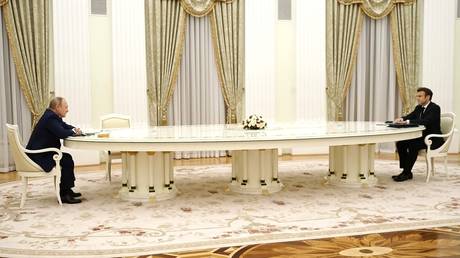 Paris says it will decide on how to proceed on the potential top-level talks with Russia in the coming days
Read Full Article at RT.com
More results...
Paris says it will decide on how to proceed on the potential top-level talks with Russia in the coming days
Read Full Article at RT.com
A third oil tanker in the Caribbean was boarded and seized Sunday by the U.S. military as the Trump administration’s military threats against Venezuela continue to escalate, Bloomberg reported.The vessel is known as the “Bella 1,” a sea vessel sanctio…
Bringing together researchers and students to watch a pop culture artefact and discuss its implications for IR is a very accessible way to enter into expert conversations.
Group of 120 experts including Joseph Stiglitz urge fresh debt restructuring plan given scale of destructionA group of the world’s top economists – including the Nobel prize winner Joseph Stiglitz – have called for Sri Lanka’s debt payments to be suspe…
Full disclosure: I’m a researcher at CyberArk Labs.
This is a technical deep dive from our threat research team, no marketing fluff, just code and methodology.
Static analysis tools like CodeQL are great at identifying “maybe” issues, but the signal-to-noise ratio is often overwhelming. You get thousands of alerts, and manually triaging them is impossible.
We built an open-source tool, Vulnhalla, to address this issue. It queries CodeQL’s “haystack” into GPT-4o, which reasons about the code context to verify if the alert is legitimate.
The sheer volume of false positives often tricks us into thinking a codebase is “clean enough” just because we can’t physically get through the backlog. This creates a significant amount of frustration for us. Still, the vulnerabilities remain, hidden in the noise.
Once we used GPT-4o to strip away ~96% of the false positives, we uncovered confirmed CVEs in the Linux Kernel, FFmpeg, Redis, Bullet3, and RetroArch. We found these in just 2 days of running the tool and triaging the output (total API cost <$80).
Running the tool for longer periods, with improved models, can reveal many additional vulnerabilities.
Write-up & Tool:
submitted by /u/ES_CY
[link] [comments]
The r/CredibleDefense daily megathread is for asking questions and posting submissions that would not fit the criteria of our post submissions. As such, submissions are less stringently moderated, but we still do keep an elevated guideline for comments.
Comment guidelines:
Please do:
* Be curious not judgmental, polite and civil,
* Link to the article or source of information that you are referring to,
* Clearly separate your opinion from what the source says. Minimize editorializing. Do _not_ cherry pick facts to support a preferred narrative,
* Read the articles before you comment, and comment on the content of the articles,
* Post only credible information
* Read our in depth rules https://reddit.com/r/CredibleDefense/wiki/rules
Please do not:
* Use memes, emojis, swear, foul imagery, acronyms like LOL, LMAO, WTF,
* Start fights with other commenters and make it personal,
* Try to push narratives, fight for a cause in the comment section, nor try to ‘win the war,’
* Engage in baseless speculation, fear mongering, or anxiety posting. Question asking is welcome and encouraged, but questions should focus on tangible issues and not groundless hypothetical scenarios. Before asking a question ask yourself ‘How likely is this thing to occur.’ Questions, like other kinds of comments, should be supported by evidence and must maintain the burden of credibility.
submitted by /u/AutoModerator
[link] [comments]
What cyber trends and predictions are coming for 2026? Here’s your annual security industry prediction report roundup for the new year, highlighting insights from the top vendors, publications and thought leaders.
Government data has been stolen in a cyberattack, though officials say the risk to individuals remains low, according to a UK minister. The incident has prompted an ongoing investigation and renewed warnings from cybersecurity experts about the long-term risks of state-linked digital espionage. Trade Minister Chris Bryant confirmed the breach in an interview with BBC […]
The post UK Government Data Stolen in Cyberattack appeared first on IT Security Guru.
England appears to be on the edge of a shift away from its traditional Labour-Conservative axis, to more radical parties such as Reform UK and the Greens.
Israel Turns to India as Western Arms Embargoes Bite Over Gaza War
As Western nations tighten restrictions on arms exports over the Gaza conflict, Israel is recalibrating its defence partnerships—placing India at the centre of its long-term strategic and manufacturing plans.
Officials in Tel Aviv and Jerusalem acknowledge that embargoes and informal curbs imposed by several European and allied countries have forced Israel to reassess who its dependable partners truly are. India, they say, has emerged as a trusted ally not only for defence procurement but also for large-scale production and technology collaboration.
“We have realised who our real friends are. India is indeed a friend, and we are looking at expanding our bilateral defence cooperation,” an Israeli official said during a recent interaction with ThePrint.
Since the Gaza war escalated in 2023, pressure on Israel’s defence sector has intensified. Spain imposed a full arms embargo in October 2025, cancelling existing contracts and blocking dual-use technologies. Earlier, Madrid denied port access to a Danish ship carrying 27 tonnes of explosives from India to Israel.
Other countries—including the Netherlands, Belgium, Slovenia, Canada, and Japan—have introduced outright bans or near-total restrictions on military trade. While Italy has not announced a formal embargo, labour unions blocked suspected arms shipments in September. Germany’s Lufthansa has halted military cargo flights to Tel Aviv due to British export controls, and France and the UK are considering limits on sub-system exports.
A joint statement by multiple Western governments and the EU’s foreign policy chief warning against Israel’s planned Gaza City takeover underscored growing international unease over civilian casualties and humanitarian law concerns.
Against this backdrop, Israel is seeking to diversify its defence production beyond its borders. Geographic limitations, security risks, and supply-chain vulnerabilities have strengthened the case for overseas manufacturing—preferably in politically reliable countries.
India fits that requirement.
Israeli officials see India not just as a buyer but as a global manufacturing base capable of producing systems for Israel’s own needs as well as for export markets.
“Israel needs defence production facilities beyond its borders, preferably in friendly countries. India is one such location,” a source noted.
The push gained momentum during Indian Defence Secretary Rajesh Kumar Singh’s visit to Israel in early November, where he co-chaired the India-Israel Joint Working Group on defence cooperation.
The discussions resulted in a memorandum of understanding covering joint development, co-production, technology transfer, and collaboration in artificial intelligence, cyber warfare, training, and R&D.
Indian officials describe the partnership as mutually beneficial.
“Israel has cutting-edge technology, and India has the ability to scale up manufacturing. It is a win-win,” an Indian official said.
Israeli companies are now awaiting adjustments to India’s joint-venture rules, FDI norms, and Defence Acquisition Procedure to move ahead with large projects.
India’s drive for indigenisation has reduced Israel’s share in Indian arms imports—from 34 percent between 2015 and 2019 to single digits by 2025. France and Russia now rank ahead. Yet Israel remains among India’s key defence suppliers, with the relationship evolving toward long-term co-development rather than simple sales.
Prime Minister Benjamin Netanyahu’s expected visit to India—dates yet to be finalised—is likely to accelerate this transition, potentially locking in commitments aligned with India’s Make in India initiative.
As Western arms restrictions persist, Israel appears increasingly anchored to India as its most dependable defence partner in Asia—one capable of sustaining innovation, production, and strategic depth in an uncertain global environment.
